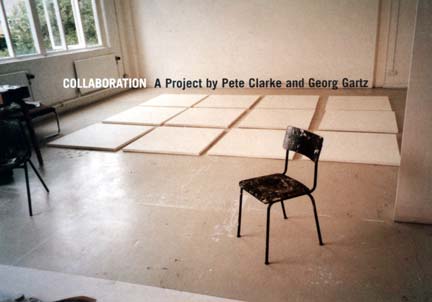
Pete
Clarke / Georg Gartz: Collaboration
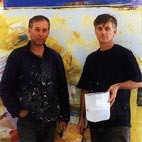
In many ways the painting collaboration between Pete Clarke and
Georg Gartz reflects the context from which their project sprang.
Two artists from two cities, Liverpool and Cologne, who met during
the planning of an event, Eight Days a Week'. This celebration
of Merseyside art and culture, staged in Liverpool's German partner
city in 1998, was the most expansive manifestation to date of
a twinning relationship stretching back to 1952.
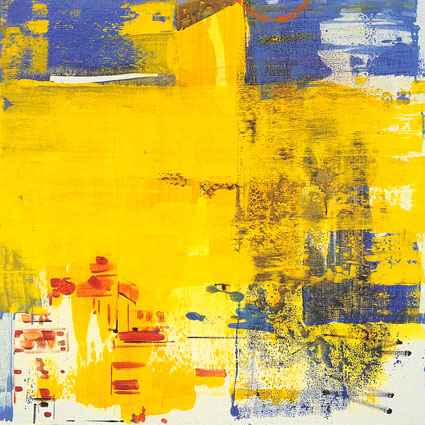 |
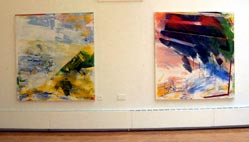
Yellow
drag over blue construction
(Acrylic on Canvas,36 x 36 inchs,Dec 1998)
|
| |
Over
the past half century, both cities have witnessed processes of
profound transformation: Colognes postwar reconstruction, prosperity
and development as an important regional centre, Liverpool's pop
music explosion, its economic de¬cline and current regeneration.
Both are also characterised by the shaping of particularly distinct
cultural identities. And just as the way in which such chan¬ges
have happened has differed greatly in each place, the two artists
on the surface at least could not be more of a contrast: Clarke,
the gritty urbanist playing with the politics of representation
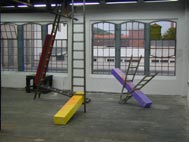
Gartz, the lyrical abstractionist whose approach to colour and
form finds expression equally through installations as conventional
painting. Yet, like the rivers that historically have provided
the life¬blood of both Cologne and Liverpool, the two artists
found in the practice of painting a common thread, a discipline
that has brought them together.
It was the topographies of their respective cities that provided
the starting point for this remarkably fruitful collaboration.
Since December 1998 they have made time to visit each others studio,
working together on the same canvases, an intensive process that
starts with an obvious reference a recognisable symbol, the shape
of the cities' cathedrals, the river perhaps then develops as
the artists respond to each other's painted marks. Through this
dialogic process a body of painting has emerged which offers us,
not a series of composite impres¬sions of the urban landscape,
but a kind of visual meditation on the city, an amalgam of different
perspectives. The paintings raise questions about how we picture
the world, challenging the notion of a single fixed authorial
point of view.
They also interrogate the practice of painting itself through
the methodology of the collaborative approach the process of applying
paint to canvas becoming a discursive act. The closest parallel
to this creative collaboration is perhaps to be found in jazz:
accomplished musicians in their own right coming together in a
spirit of openness, willing to give and take, feeding off each
other through improvisatory expression. And like the best jazz
ensembles, the artists here anchor their enter¬prise in a
structure, a springboard from which to explore new territory.
Whilst in visual art this is not a particularly new innovation
one thinks of Warhols celebrated collaboration with Basquiat for
example the partnership between Clarke and Gartz is not some exotic
pairing. Instead, at the heart of their interaction is a genuine
desire to challenge their own and the audiences preconceptions
about the creative process, formally, conceptually and culturally.
It is an approach that provides a challenge as well as a model
for artists from Cologne and Liverpool in the continuing dialogue
and exchange between the two cities.
Bryan Biggs, Bluecoat Gallery, Liverpool
 |
Red
Triangle and River Wash,
(Acrylic on Canvas,36 x 36 inchs,Dec1998)
|
Turner’s
Travels
Clarke and Gartz embarked on the Project ‘Turner’s
Travels’ [J.M.W. Turner 1775 – 1851] given the significance
of the artist to German and British Art. The ‘Collaboration’
project followed Turner’s travels along the Rivers Rhine
and Mosel in 2007. The research compared and contrasted significant
works by revisiting iconic places depicted in Turner’s paintings
and sketchbooks producing new transcriptions and re-invented images.
The historic work of Turner was used as metaphor for concepts
of national influence and cultural production within contemporary
art.
 |
| |
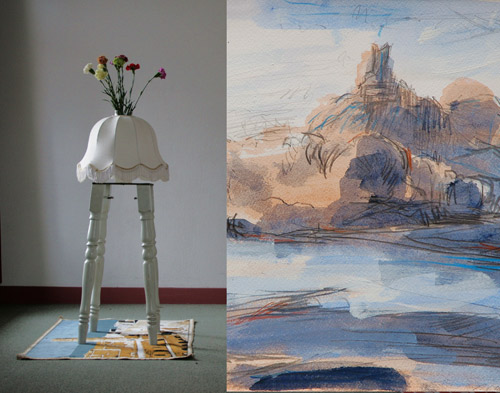 |
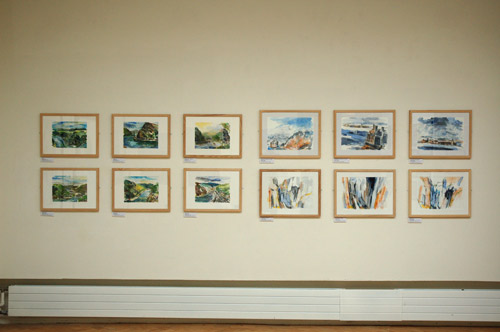
Clarke and Gartz were invited to have the ‘Retrospective
of Ten Years of Collaboration’ featuring the paintings ‘Rheinwärts’
and the drawings ‘Rheinlust’ at Museum Zündorfer
Wehrturm, Köln in 2008. ‘Rheinlust’ was initially
exhibited as a major part of the ‘Die Lange Nacht der Museen’
2007 [the long night of the museums] when Köln had a celebratory
evening for the visual arts organised by the City of Köln
and sponsored by the Stadt Review. The ‘Rheinwärts’
exhibition included the illustrated catalogue ‘the Collaborative
Painting Project by Clarke & Gartz’ with contextual
essay written by Art Historian Anke von Heyl.
‘Turner’s travels’ has now continued with more
drawings exploring North Yorkshire [2008] with a Residency in
2008 at the Bluecoat, part of ‘Eight Days a Week’
and Liverpool European City of Culture, Venice [2009] and the
Isle of Wight [2011]. Clarke and Gartz recently exhibited the
series of drawings and a new reinvented installation of the Rhine
at the ‘Lorelei’ for the exhibition ‘Ist es
am Rhein so schön?’ Kunstverein, Köln 2011.
In 2013 Clarke and Gartz exhibited paintings and drawings as a
companion to ‘Travels with Turner’ the travelling
exhibition of Turner’s engravings ‘Liber Studiorum’,
Kirkby Gallery, Merseyside. Later in 2013 they continued this
Turner project with more drawings of the Rhine – images
of the Lorelei and the iconic Ehrenbreitstein fortress near Coblenz.
This project has now led to their appointment as ‘artists
in residence’ in 2015 at the Rhineland spa town of Ebernburg,
located at the tributary of the river Nahe, an area of mountains,
vineyards and craggy massifs where Turner made significant work
in 1844.