Project
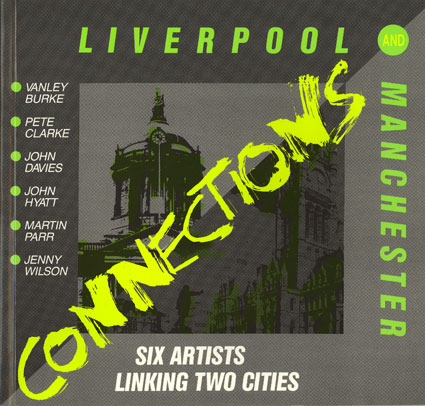
7 : Connections: Liverpool and Manchester
Connections and Contradictions (The Burning of the Town
Halls), Text by David Campbell 1986
For some, Connections is clear; such an assertive title
for a body of work, pregnant with possibilities. It offers
itself up as a context from which a yield of forthright,
if not definitive statements could be obtained. Not only
does it seem to guarantee 'conclusions', but it also assumed
a straight- forward process of meaning; one which is diagramatic
-even illustrative.
Premised upon the belief that the author of the work will
somehow direct a transfer of' information' in the form of'
facts' derived from the 'real world' in a form which will
best illustrate the privileged vision of the author. All
that is required from the viewer is the reception of this
'meaning' communicated to her/him when this is completed
we can all bask in the obviousness of the insight, now apparent
to all, the conclusions-the connections have been pointed
out and we are without darkness!
Within the cluster of terms orbiting 'connections' and its
potential meanings, it would seem to me those of fact, truth,
evidence, proof and understanding are central to its working.
In the caricature form of visionary outlined in the first
paragraph, these points of reference are seen as unproblematic;
they fall into place in a mechanical procedure which commences
with 'facts', discovered by the artist, being communicated
through the work, culminating in 'truth' being offered to
the viewer to accept. It is simple, clear-cut, mechanical
as far as I'm concerned, a complete fantasy.
 |
Municipal
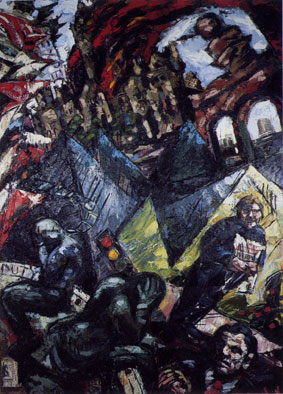
Modernism: The Cloth Cap and the Red Glove |
Connections and Contradictions (The Burning of the Town
Halls)
To begin with it adopts the lumbering hypothesis of the
form/content distinction, here in the guise of a 'content'
about Manchester and Liverpool in political, economic, social
or cultural terms which exists, yet has to be given form
to be understood. The 'form' is the 'artistic bit', that
which will deliver the 'content'; into which the content
will be poured. Form must allow itself to be consumed by
content, and yet be as transparent as possible, it must
not interfere with the meaning of content. For those who
operate by this rationale, and there are many, the normal
state of affairs is to describe the 'form' as neutral, allowing
the content to be judged in respect to a hierarchy of values
set elsewhere. 'Good old form' is just form, untouched by
history or ideology; it can be resalvaged and brought back
within the citadels of aesthetic purification, after convalescence
and cleansing it can be protected from those unsavoury kidnappers
who, in their philistine manner, would attempt to despoil
form in the service of some 'alien content'. The customs
officers of formal integrity mount a constant battle to
retain the soiled virtue of form, in fact there are many
institutions dedicated to it's preservation!
Content, stripped of its passport to form, is in this scenario
understood, through a leap of absurdity, as existing in
some form of non state, a void without form.
Extreme as my description may be, in substance I think it
captures the debilitating conclusions obtained through the
retarded form/content debate and as a counter I would simply
like to raise the question: in the very instance of the
enunciation of content, is it not given form? Can we even
conceive or talk about content, if not through formal languages
produced within the confines of historically specific ideological
formations? If content has form, then form convention bound
and historically produced must be understood as content
by virtue of accrued social usage.
With the dislocation of the form/content axis, we are forced
into re evaluating the validity of what is usually called
'authorial intent'. For if content is now understood as
incorporating formal considerations, which actually determine
the meanings constructed for a work through the play of
its particular grammer, then we can no longer talk in terms
of pre established meanings being communicated by an author
in a direct manner to a viewer, rather we have to consider
this as a process not of communication but of signification.
One open to the notion of negotiability of meanings, an
active process of construction, rather than the act of passive
consumption.
A signifying practice, through the play of signs with social
currency, offers a range of possible meanings produced in
the engagement with specific bodies of knowledge possessed
by the viewers. It is through this interplay, and the degree
to which they appear to function as valid representations,
that the very notion of coherence is produced and meaning
is fixed. It is a process constantly in flux, gone are the
certainties of simply communicating a 'fact' to an audience,
meanings have to be constructed and fought for in a dynamic
process with no end. Those who seek certainty and reach
for the secure, the fixed, and the solid are fossilised
in the process; history is full of the accumulated debris
of such mute gestures, they make up the landscape on which
the battles of today are now being fought.
In this context Connections should be posed in a questioning
tone rather than the demand for certainty in unambiguous
form. Caution and stealth would be appropriate lines of
development, allied to a healthy cynicism about the possibility
of any hard and fast results or meanings being secured.
In addition, an understanding of what constitutes questions
and how they are articulated, in part determines the answers
obtained. A significant art practice would need to incorporate
these insights within the very operation of its practice,
acutely aware of its own construction and the procedures
by which it could secure new meanings within the various
communities of audience.
This is perhaps more urgent when applied to the undercurrent
of this exhibition, suggesting as it does, the possibilities
of points of relation between the cities of Liverpool and
Manchester. In one sense the project must be seen as a curatorial
reflex, animated by a range of concerns, but beyond those,
it does assume that there are significant features of compatability
or relation between the two cities; but what are they? What
is this imagined backdrop of reference, and further, speaking
in a fairly utilitarian manner, what would be the function
of drawing out these connections in 1986, apart from the
mundane aspect of galleries in the two cities having exhibitions
to show.
 |
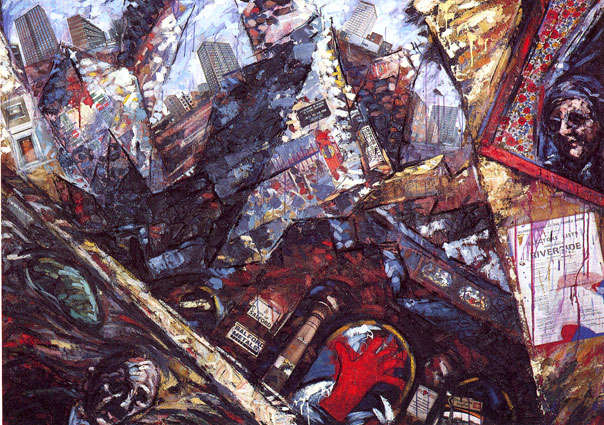
The
Red Town halls: Two Nations, Two Cities.
(Oil and
mixed media on canvas) |
Is it something particular about Liverpool and Manchester,
a special relation between the two?
In one sense this could apply, but the 'connection' will
be wide in its interpretation, or are Liverpool and Manchester
able to function in a much wider scenario, as representative
of other cities, situations, processes? Are they able to
be offered up as tokens as to what is happening on an extended
scale in 'the North' in Britain, Western Europe, in terms
of economics, politics and culture in 1986. In otherwords,
can Liverpool and Manchester be understood as condensations
for a range of complexities which are being restructured
at this time. It would seem to me to be the case that the
term restructuring can never be too far from our lips today,
as it is constantly inserted into a range of situations
often as a justification for actions with devastating social
results.
In any case when we speak of Liverpool and Manchester, what
exactly do we mean?
A geographic location, a political formation, the accrued
fabric of history in physical form, of buildings, of monuments,
of football teams, of specific cultural forms, of accents,
of manufacturing skills, of economic foundations, of history,
of futures or their possibilities? What constellation of
elements bind to make a Manchester or a Liverpool and are
they not in the plural? In what frame of reference are they
structured and is it that to which we must turn our attention,
of that which we must talk? It seems as if Manchester and
Liverpool and their connections are representative of elements
in operation within a much larger narrative; a narrative
whose process is given form in those complex entities to
which we give the names Liverpool and Manchester.
It would be the task of those partaking in this project
to sustain analysis of what grouping of processes are at
work and the representations they secure in very specific
forms. How Manchester and Liverpool are constructed as meanings
will help us produce an understanding of the rationale of
the system in which they are indexed and by which they are
determined. Liverpool and Manchester in 1986 will help us
understand the processes in which we are all implicated:
the struggle of the economic, political as well as the cultural.
What will be at stake will be the very notion of history,
its forces and mode of operation.
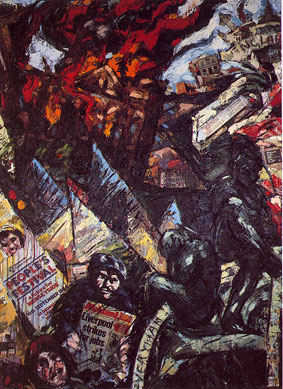 |
|
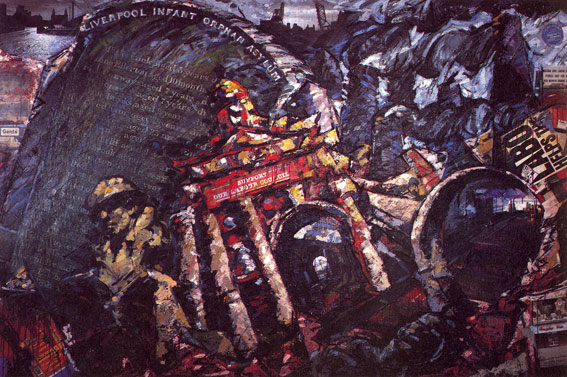
The
Burning of the Town Halls.
(Oil and mixed media on canvas) |
By
what process will all this be put into action? On entering
the exhibition space, what is to be our expectation of the
work and could not a sense of the unexpected be a legitimate
goal towards which we may work. What we must concede is
that we all have expectations about what might form the
substance of this exhibition. There are points of condensation
to which one would expect investigation to be directed,
we have notions of what Liverpool and Manchester and their
connections are. As to what these are; how they are produced
and reproduced and the degree to which they are seen as
'truthful' to our experience determines in part the kind
of meanings we can construct for the futureIt is a future
which seems to demand a quite radical break from the past.
For as they now operate in the present scheme of understanding,
to even talk about these cities as 'future' goes against
the current rationale, and to some extent this exhibition
would need to address itself to the situation in which Liverpool
and Manchester are being talked about as if they were synonymous
with history.
Not the living forces of historical processes, but a decaying
remnant an historical curiosity which, at worst, has to
be allowed or assisted to expire, so that it can be isolated
from the rest of the social body for fear of contamination,
or, at best, exposed to a form of selective preservation.
One in which the fabric of people's social existence becomes
a glorified 'theme park', where 'archaic' means of production,
stunted in physical form, become open air industrial museums;
mumification taking place at ever increasing speeds, history
veraciously consumed as just another set of objects to look
at on a Sunday afternoon. We are becoming a division of
the tourist industry; our environments and history a huge
show case; so what does that make us the tourists or the
exhibits? .
This is a form of'history' which is unhistorical, for it
estranges the 'landscape' of production from the condition
which produced it and which in turn it reproduced. It is
a history which we are encouraged to consume, but not learn
from. We look at the objects of history, but they tell us
nothing other than this is history in these objects, today
we have different objects so things must have changed! Look,
things were bad in the past; crude, noisy, dirty, oppressive,
but now that this is no longer the case, we have advanced.
History is ordered, it can be checked in catalogues, it
is safe and even quaint it certainly cannot harm us.
How then do we insert the 'historical' back into our environment
and the way we make sense of it; how can we learn from it,
so that we become the subjects of our history? How can we
produce an understanding of history not as a group of objects,
but as a dynamic process shaping our lives and our futures?
This
is a task that has to be put into operation and it demands
a fluidity of approach, one in which the construction of
the artwork not only articulates the diversity of signs
making up our experience of the world, but also that the
manner of their organisation constitutes a historical process,
which must be understood.
So what kind of practice will this involve?
One capable of carrying within the mechanics of it's own
operation the complexities of meaning. Not only does it
have to produce meaning, but it would need to lay bare the
process by which it did so, it must attempt to achieve a
dialectical unity in which 'meaning is process', a process
in which the viewer is actively engaged. This engagement,
in an attempt to produce knowledge, may be one fissured
with uncertainty, inquiry and even difficulty; but it does
not adopt these conditions for their own sake, as a form
of elitist foil, rather they are the conditions for moving
beyond the role of passive consumer and fulfilling a much
more demanding one, that of a participant in the production
of knowledge.
Collage, in its much wider definition, would seem to be
a process in which this attempt could be best achieved;
at least it extends in a diverse manner the opportunities
for the mechanics of representation to be exposed. Collage
represents a radical break in the techniques of composition
developed since the Renaissance, and is distinguished from
the tradition of the fixed view point and it's schema of
illusionism, by the insertion of fragments of reality into
the painting; material left unchanged by the artist. In
such a moment there is a destruction of the unity of the
painting as a whole, for the system of representation based
on the portrayal of reality fashioned by the subjectivity
of its creator has been breached.
When a glove or a piece of product packaging are glued on
to a canvas, they are no longer merely signs pointing to
reality, but they are fragments of reality. They act as
blockages to the apparently seemless flow of knowledge produced
within those systems of representation, disrupting their
naturalness, and in the same instance, in a reflex of self
exposure, drawing attention to the fact that it is a system
of representation, bound by convention and historically
produced.But what of the complexities which produce Manchester
and Liverpool? One aspect could be the 'historical' nineteenth
century Manchester and Liverpool; the municipal solemnity
of it's architecture, the grandiosity of a confident and
successful bourgeoisie in the form of public display of
power and stability; order posed in architecural as well
as social terms.
The remnants of that phase of industrial development still
litter the urban environment, now in the form of shadows
around which we physically experience the city, but shadows
also in the sense that the power which enabled their construction
and of which they were proof and celebration, has seemingly
moved elsewhere.In the move to display and fix an economic/political
power in architectural form, we witness the fossilisation
of that form as power; the limits of that power, its identity
as a historical 'present' in a process which never lingers
which always moves on and has to continually revolutionise
itself. Yet how can this be maintained when simultaneous
with the demand to revolutionise is the imperative to present
itself as order the natural culmination of a process of
modernisation. This is the millstone around the bourgeoisie's
neck; forced to deny the character of its own identity,
it adopts the mantle of disguise; a desperate game of bluff
and reassurance ensues. Nonetheless revolutionary the bourgeoisie
were; Marx writing the Communist Manifesto in 1848 could
write: 'The bourgeoisie, in its reign of barely a hundred
years, has created more massive and more colossal productive
power than all previous generations put together.
Subjection of nature's forces to man, machine,' application
of chemistry to agriculture and industry, steam navigation,
railways, electric telegraphs, clearing whole continents
for cultivation, canalisation of rivers, whole populations
conjured out of the ground what earlier century had even
an intimation that such productive powers slept in the womb
of social labour?" Marx goes on to point out that is
not only productive power that sleeps in the womb of social
labour, but that the bourgeoisie, through their relations
of production, brought about an enormous accumulation of
workers, who through their organisation and concerted action
achieve massive feats of production. This process also demonstrates
the power of organisation and concerted action as a means
to other ends; towards goals not directed at simply making
a profit, but which embrace the diversity of human potential
and need. The bourgeoisie have set in operation a model:
that of organisation and united action; they have shown
it to work, and this is the danger for in showing it have
they not provided the weapons for their own destruction?
Could not men and women organise and work together and fight
to change the world even further; must we simply accept
the structure of our society, the bourgeoisie didn't so
why should we?
It is with this realisation that the bourgeoisie attempts
to deny its own identity as being a product of a revolutionary
process; "if there was a process and it were once revolutionary,
then itisno longer, is the reply offered; it has reached
its culmination in the existing social order the bourgeoisie
are the end stop, or so they would like us to believe. Ushered
away is the history of continual overthrow of all previous
orders, for if this was not denied, then whatwill prevent
the conclusion being drawn that the bourgeoisie will likewise
be subjected to the same fate. Overthrown by the class formed
within the relations of bourgeois production: the proletariat
what exquisite irony!
So
we have the paradox of a system, animated by the need for
constant revolutionising of the means of production, denying
further revolution and attempting to make solid and monumental
that denial. In the end, of course, it is the process which
the bourgeoisie themselves put in operation which will prevail,
it is central to their very definition and infuses their
every action.