Project 14 : Poetry Beyond Text
Poetry Beyond Text: Vision and Cognition is a multi-disciplinary
research project funded by the Arts and Humanities Research
Council and based at the Universities of Dundee and Kent.
The project uses methods from literary criticism, aesthetics,
experimental psychology, fine art and creative practice
to study how readers respond to hybrid works which combine
the textual with the visual, including digital poetry, concrete
and visual poetry, artists' books, text film and poetry
combined with photography. The project commissioned poets
and artists to make work together including Will Maclean,
John Burnside, Robert Sheppard & Pete Clarke, Thomas
A. Clark, Marian Leven, Robin Robertson, John Cayley, Simon
Biggs, Deryn Rees-Jones and Giselle Beiguelman.
 |
| |
As an interdisciplinary project ‘Poetry Beyond Text’
focusses on four key research questions:
1. When art works combine textual and visual elements, how
do the modes of attention specific to reading text and viewing
images interact and modify each other?
2. What factors determine whether the combination of textual
and visual elements in such works enriches or limits their
meaning and aesthetic value?
3. How are evaluative and interpretive responses to such
works affected by the development of enhanced reflective
awareness about the processes involved?
4. How can critical and psychological models of perception
and aesthetic experience inform and be informed by the creation
of new works of art?
‘Poetry Beyond Text: Vision, Text + Cognition’
ISBN 978-0-9568371-0-3
Pete Clarke and Robert Sheppard ‘Poetic Collaborations’
Pete Clarke and Robert Sheppard, Professor of Professor
of Poetry and Poetics at Edge Hill University after this
initial project invitation have continued working exploring
image and text based on Sheppard’s published works.
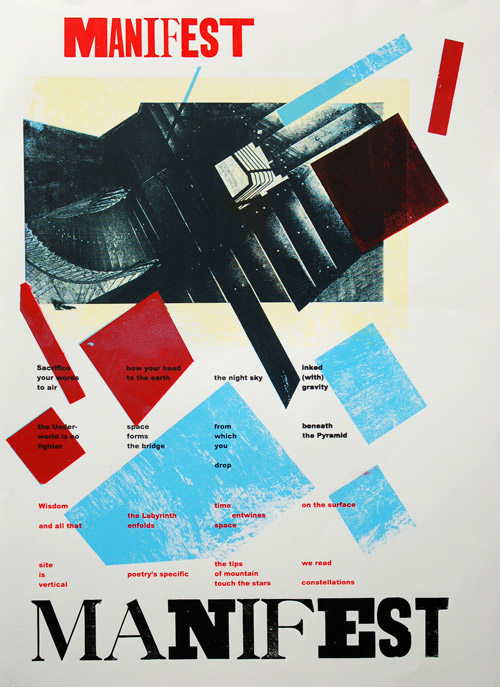
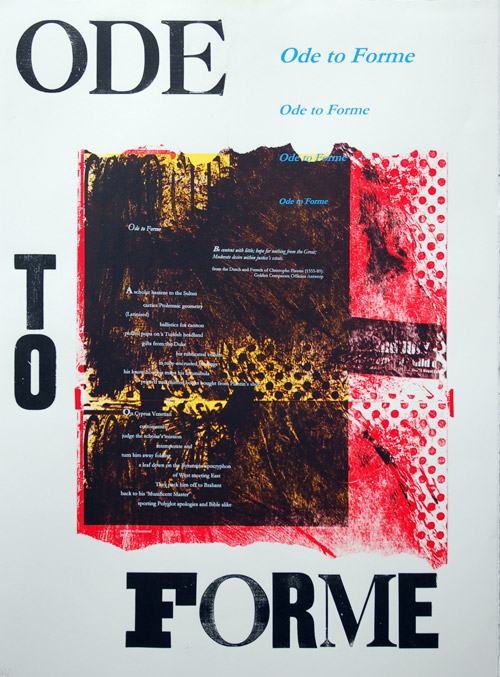
They collaborated on a letterpress, woodcut and silkscreen
printmaking series -‘Forme’, ‘Lyric’,
‘Manifest’, ‘This is not Guilt’
and ‘Tangled Scree’.
‘Each of these prints contains poetic text on various
scales, some resembling ‘headlines’ or titles,
others reading as fragmented and repeated ‘body’
text. There is a visual assembly of these component elements
that is suggestive of Russian Constructivist prints, combining
abstract colour shapes, blocks of text, and oblique angles
and these historical visual influences interact with a ‘poetic
of increased indeterminacy and discontinuity, the uses of
techniques of disruption and of creative linkage’,
to apply Sheppard’s own description of the ‘Linguistically
Innovative Poetry’ movement in which he has played
a notable part. The word manifest teases the viewer with
overtones of manifestos, of historical references and political
activism in its dynamic layout. There are visual overtones
as well of the dynamic aesthetics of Rodchenko and Popova,
whose work from the brief period from 1917-1925 produced
energetic and stylistically groundbreaking visual art with
text’.
www.poetrybeyondtext.org
www.poetrybeyondtext.org/clarke-sheppard.html
 |
| |
 |
| |
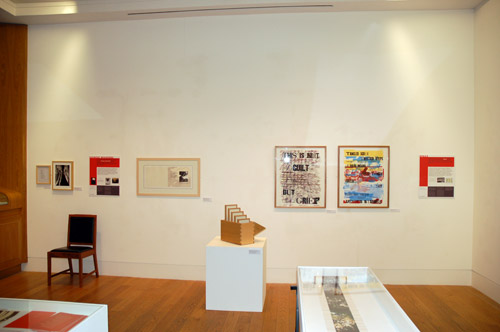
‘Visual Research Centre’, Dundee Contemporary
Arts March-April 2011,
‘Scottish Poetry Library’, Edinburgh May-July
2011
‘Royal Scottish Academy’, Edinburgh November-December
2011
‘Get Back’ Graphic Works, Kunstraum Dreizwanzig,
Cologne 2012
Catalogue ISBN 9781901922875
‘Manifest’, The Arts Centre, Edge Hill University,
exhibition and symposium April 2013
'Dusseldoffer Poesietage' Betonbox, Duusseldorf 2016.
An overview and critical presentation of Clarke and Sheppard’s
collaboration was presented in a research symposium at the
Arts Centre, Edge Hill University exploring ideas around
cultural collaborations in April 2013. Dr Patricia Farrell
gave a critical paper on the Clarke Sheppard collaboration
which was then presented in a research forum at Strathclyde
University in 2013.
Robert Sheppard moved to Liverpool in 1997
and works at Edge Hill University where he is currently
Professor of Poetry and Poetics. Books include Twentieth
Century Blues, Warrant Error and Berlin Bursts.
www.robertsheppard.blogspot.com